CROSS: Visual multi-session SLAM
that survives change

Map a place once. Come back at night, in another season, after the furniture moved, or with another camera: CROSS finds where it is, keeps tracking and extends the same map, for long-term, multi-session navigation.

bash install.sh --stereo

Highlights

Every clip is a real run

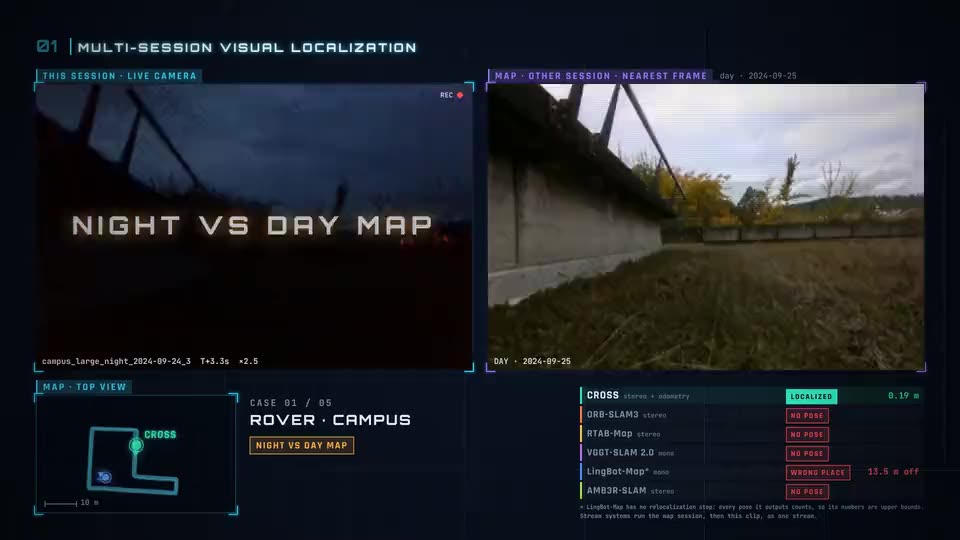
01 RelocalizationROVER campus

Night, in a map made by day

A night session, in a map recorded by day. CROSS finds its place in the map; the five other systems shown give no pose or the wrong place.

Relocalizationin a map from another session

Trackingany sensor setup

Large scalewith or without GPS

Deploymentedge and cloud, any camera

Summary

CROSS maps a place once and finds its way back into that map in every later session: at night, across seasons, after the furniture moved, or with another camera. It treats every visual match as a pose hypothesis and commits only what the robot's own motion confirms, so a single look-alike view cannot corrupt the map. RGB-D, stereo or monocular; with wheel odometry, a VIO, an IMU or none.

CROSS with a stereo camera, in the CROSS benchmark, against open-source SLAM systems run on the same sessions. Figures with odometry use the recommended stereo + odometry mode: wheel odometry on OpenLORIS, dead reckoning from the car's INS on KITTI (close to the ground truth), and odometry simulated from ground truth plus noise on ROVER and SimChange, where no wheel odometry was recorded; every system that takes odometry gets the same. How it was measured

Overview

Best multi-session relocalization

Start anywhere in a map from another session, at night, in snow, in a crowd or with the lights off, and CROSS finds where it is. The best visual multi-session relocalization in our benchmark →

Night in a day map, ROVER
Lights off, OpenLORIS
Snow in a summer map, NCLT
Busy café, OpenLORIS

Accurate tracking, any sensor setup

Accurate tracking with RGB-D, stereo or one camera, with wheel odometry, a VIO, an IMU or nothing at all: ready-made modes, picked with one flag.

Indoors, every setup, OpenLORIS home
Outdoor robot, ROVER
A car, eleven setups, KITTI

Large scale, with or without GPS

Sessions of kilometers, indoors and out, kept accurate by verified loop closures with or without GPS; with it, the map is placed on the Earth. Soon, several robots will build one map together.

6.5 km in one session, NCLT
Placed on the Earth with consumer GPS
Driving, KITTI 00
Three robots, one map (in development)

Light on the robot, heavy in the cloud

The robot needs under half a CPU core: it runs its odometry and sends about one frame in five to a GPU server, which does the heavy work and keeps it localized with 100 ms of added network delay. A map made with one camera also serves another camera. Remote sessions →

Half an x86 core on the robot, GPU in the cloud (replay)
Another camera, indoors
Another camera, outdoors in winter
Another camera, at night

Benchmark

6,368 runs, 6 open-source systems, 4 datasets

On the same sessions, CROSS ranks first in all three tasks: it relocalizes from a cold start far more often than any other system, keeps more of each later session localized in its map, and maps with the lowest error.

Relocalization success from 10 s cold starts, within 2 m indoors and 5 m outdoors. Higher is better.

  1. CROSSStereo + odometry93%
  2. LingBot-MapMono camera only · upper bound48%
  3. RTAB-MapRGB-D + odometry43%
  4. ORB-SLAM3Stereo + IMU41%
  5. AMB3R-SLAMRGB-D camera only18%
  6. VGGT-SLAM 2.0Mono camera only14%
  7. MASt3R-SLAMMono camera only · 9/67 query sessions failed10%

Share of a whole query session localized in a stored map, same radii. Higher is better.

  1. CROSSStereo + odometry93%
  2. ORB-SLAM3Stereo + IMU53%
  3. RTAB-MapRGB-D + IMU51%
  4. LingBot-MapMono camera only · upper bound48%
  5. AMB3R-SLAMMono camera only40%
  6. VGGT-SLAM 2.0Mono camera only15%
  7. MASt3R-SLAMMono camera only · 9/67 query sessions failed6%

Trajectory error as a share of the distance traveled. Lower is better.

  1. CROSSStereo + odometry0.35%
  2. RTAB-MapStereo + odometry0.76%
  3. AMB3R-SLAMMono camera only1.32%
  4. LingBot-MapMono camera only1.89%
  5. ORB-SLAM3Stereo camera only · 8/40 sequences failed0.49%
  6. VGGT-SLAM 2.0Mono camera only · 6/40 sequences failed3.66%
  7. MASt3R-SLAMMono camera only · 25/40 sequences failed–
  • DatasetsKITTI, OpenLORIS-Scene, ROVER over 14 months, SimChange v3
  • SystemsORB-SLAM3, RTAB-Map, MASt3R-SLAM, VGGT-SLAM 2.0, LingBot-Map, AMB3R-SLAM
  • Inputsthe same images for every system, the same odometry for every system that takes it
  • Openprotocol, runners for every system, all per-run results

CROSS in its recommended stereo + odometry mode, as in the figures above; every other system in its best configuration. Hatched: LingBot-Map has no relocalization step, so its relocalization and localization scores are upper bounds. Gray values leave failed sequences out of their mean.

Video

5:09, with sound

01 Intro0:00

CROSS in ten seconds

What it does: relocalize across sessions, with any camera setup; stay accurate in the dark and in sharp turns; map kilometers without drift; run light on the robot with the GPU in the cloud; share one map across cameras, and soon across robots.

Chapters5:09

Method

Place recognition alone confuses look-alike places, and one false loop closure can ruin a map. CROSS keeps competing answers alive and lets the robot's own motion decide between them.

  1. 01

    Remember places

    The map is a graph of keyframes, images with their poses, linked by odometry and by verified loop closures. It is saved to disk and loaded in every later session.

  2. 02

    Hypothesize poses

    Place recognition retrieves keyframes that look alike. One pass of a multi-view model, or PnP on depth, turns each into a metric pose. Competing poses live side by side in a Gaussian mixture on SE(3).

  3. 03

    Let odometry decide

    As the robot moves, hypotheses that disagree with its odometry lose weight and die out. A new session joins the map only when its placement holds over several steps and places.

  4. 04

    Commit what holds

    A loop closure enters the map only after statistical consistency tests; pose-graph optimization then removes the drift that built up in between.

The method in detail: the NeurIPS 2026 paper →

Get started

Linux, NVIDIA GPU, about 10 GB

One script installs everything into a local environment and downloads the models. Then map a session, save it, and relocalize the next session in it.

  • ReadsRGB-D and stereo folders, KITTI raw, TartanAir, Virtual KITTI 2, OpenLORIS, iPhone recordings (Record3D); TUM RGB-D after conversion
  • Install--stereo covers the RGB-D and VGGT-Omega modes; --mono adds DPVO and the monocular IMU modes
  • Pythonfeed frames, read poses in the map's coordinates
  • Robota robot without a GPU runs cross-edge, a client without PyTorch, and a GPU server does the rest: remote sessions
  • LicenseMIT-licensed code. The learned models (VGGT-Omega, Depth Anything 3) are for non-commercial research; the RGB-D modes with PnP use neither

Terminal

  1. # install: a local .venv with PyTorch, CROSS and the models
  2. $ git clone https://github.com/jiaming-ai/CROSS.git && cd CROSS
  3. $ bash install.sh --stereo && source .venv/bin/activate
  4. # two recordings of one office (OpenLORIS-Scene from Hugging Face, 10.6 GB)
  5. $ PATH="$HOME/.local/bin:$PATH" uv pip install py7zr
  6. $ bash benchmark/datasets/download_openloris.sh data/openloris office1-1_7
  7. $ python scripts/datasets/convert_openloris.py \
  8. data/openloris/office1-1 data/posed/office1-1
  9. $ python scripts/datasets/convert_openloris.py \
  10. data/openloris/office1-2 data/posed/office1-2
  11. # session 1: build a map and save it
  12. $ python run.py data/posed/office1-1 --mode rgbd_wheel \
  13. --save-map maps/office/map.pkl
  14. # session 2: relocalize in it, write poses in the map frame
  15. $ python run.py data/posed/office1-2 --mode rgbd_wheel \
  16. --load-map maps/office/map.pkl --save-poses office1-2.txt

14Modes, one per robot

CROSS sensor modes by camera and odometry source
CameraWheel or other odometryBasalt VIOIMU, fused by CROSSCamera only
Stereostereo_wheel recommendedstereo_basaltstereo_imustereo_dpvo
RGB-Drgbd_wheelrgbd_basalt–rgbd_dpvo
RGB-D, learned poses scaled by depthrgbd_ff_wheelrgbd_ff_basalt––
One cameramono_wheelmono_basaltmono_imu mono_viomono_dpvo

Scroll sideways for every column

What each mode needs →

Papers

CROSS grows paper by paper; the software follows

CROSS 1 NeurIPS 2026

Change-Robust Online Topological Memory for Long-Term Relocalization and Semantic Navigation

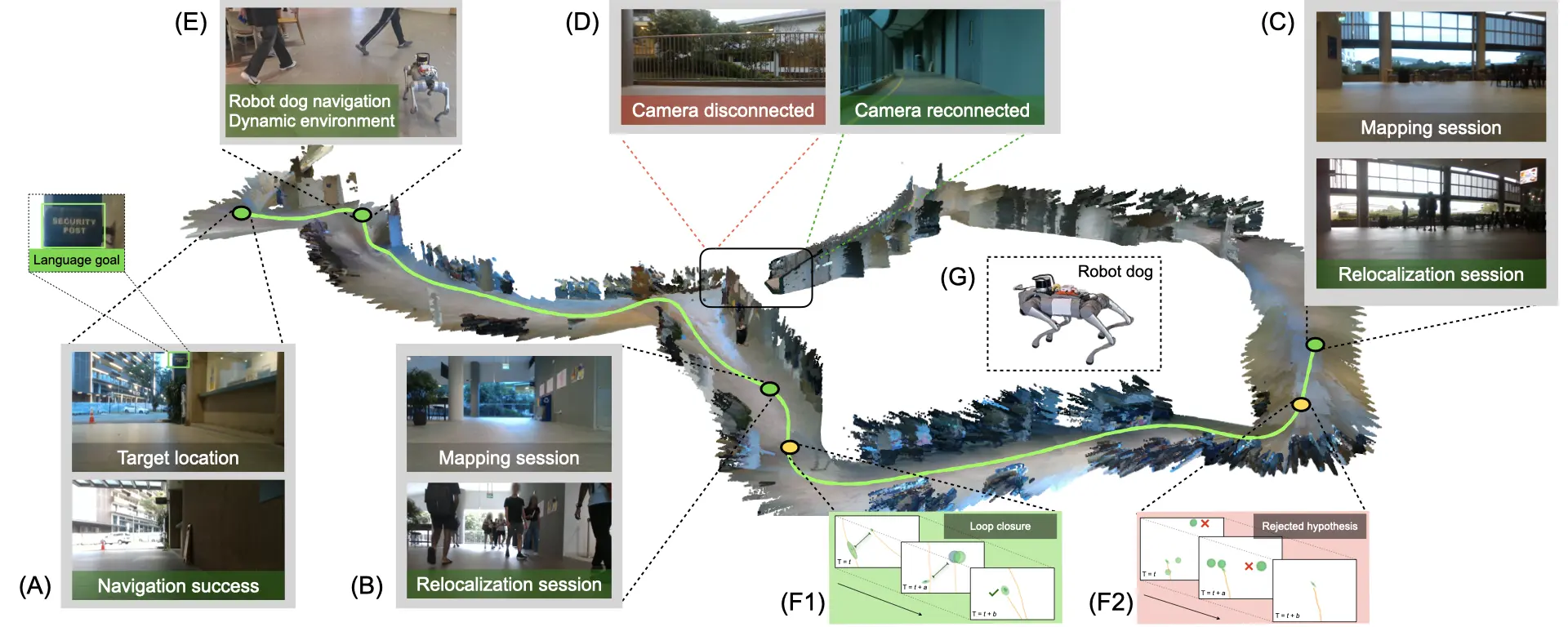
Every visual match becomes a pose hypothesis that odometry must confirm before it reaches the map; a quadruped navigates to language goals in maps from another session.

  • Relocalization in a map from another session
  • Language goals reached on a real quadruped
  • Look-alike places ruled out by the robot's motion
  • Real time on one GPU

Jiaming Wang, Jizhuo Chen, Diwen Liu, Atharva Ghotavadekar, Jiaxuan Da, Linh Kästner, Harold Soh

CROSS 2

Learned multi-view geometry

A feed-forward multi-view model replaces feature matching for relative poses, made metric and verified before it reaches the map.

Paper coming soon

CROSS 3

Large-scale, long-term mapping

Kilometer-scale maps reused over many sessions, outdoors and with more than one camera.

Paper coming soon

CROSS Cloud

Relocalization with a remote GPU

The robot keeps its odometry and a live pose; a GPU server runs the model and the map over the network.

Paper coming soon

BibTeX

Using CROSS in your research? Please cite the NeurIPS 2026 paper.

@inproceedings{wang2026cross,
  title     = {Change-Robust Online Topological Memory for Long-Term
               Relocalization and Semantic Navigation},
  author    = {Wang, Jiaming and Chen, Jizhuo and Liu, Diwen and
               Ghotavadekar, Atharva and Da, Jiaxuan and K{\"a}stner, Linh
               and Soh, Harold},
  booktitle = {Advances in Neural Information Processing Systems (NeurIPS)},
  year      = {2026},
  eprint    = {2605.02227},
  archivePrefix = {arXiv}
}